Article Summary: Durso et al. (2014) Human Factors – Oxford Bibliography

Motivation: Create an annotated bibliography of Human Factors that introduces and organizes its sub-fields and seminal works.

Outline: Human Factors is a field of psychology that examines how humans interact with technology, so we organized this bibliography around the factors that affect this interaction. After a general overview of the field and its methods, we introduce psychological factors from sources both internal, in “Perceptual and Cognitive Factors,” and external, in “Organizational and Social Factors.” Next, we discuss how to apply these factors to designing systems that match the capabilities and limitations of humans both cognitively, in “Cognitive Factors in Design,” and physically, in “Physical Factors in Design.” Finally, we describe factors that affect users once they start interacting with a system in “Deployment Factors.” Continue reading

Article Summary: Posner (2011) Proficiency-Based Assessment

Motivation: Most STEM courses use summative assessment almost exclusively, and this practice fails to foster student learning and engagement. To improve learning outcomes, we need to develop, test, and implement formative assessment practices.

Intervention: This study uses a proficiency-based assessment tool for statistics education in which students can resubmit assignments to demonstrate successful achievement of learning outcomes. The tool gives scores of either Mastery, Proficient, Developing, or Not Submitted. Continue reading

Which Ones Are Not Like the Others? Why Names Matter for Flipped, Blended, and Hybrid Instruction

The conversation about flipped, blended, and hybrid courses is trying to move beyond the conventional, but it’s stuck. Without common definitions for these basic terms, educators are like chemists without the periodic table or physicists without Newton’s Laws. We cannot effectively implement new instructional methods that will improve our students’ learning if we’re not all speaking the same language.

Take “flipped courses” as an example. Most people think of a flipped course as one in which students learn content before coming to class, and then use class time to work on activities while an instructor provides feedback. In this case, a flipped course could be a discussion-based Ethics class in which students read a book beforehand and discuss it during class. Some definitions, however, specify that the before-class content must be delivered electronically. Therefore, the course would only be considered “flipped” if the book is delivered electronically. Other definitions claim that flipped courses must include group-based, procedural problem solving. Continue reading

Bad Design: What’s Behind the Door?

I’m fortunate to work in a beautiful building (see below). Unfortunately, that building is also one of the most confusing buildings I’ve ever been in. The doors pictured above are a big part of the problem. These doors don’t look very welcoming, do they? In a university context, I’d guess that they lead to a large lecture hall or some other place that you probably shouldn’t just barge into. One time a group of students asked me how to get to a classroom. After I directed them through these doors, one of them said, “Oh, I thought this would be like the boiler room or something.”

Continue reading

Bad Design: Instructions for Opening a Door

Multimedia doors

The picture above is of a typical keycard door: tap your keycard (to the right of the door), open the door. Lots of buildings are full of these types of doors. People use them every day, meaning we have knowledge of and experience with them. Yet, when I’ve used this door, I’ve done it incorrectly. More embarrassingly, I’ve used it incorrectly more than once. Even with the highly visible, 1st-grade-reading-level sign directly above the handle, I’ve tried pulling the door several times before finally pushing it. I’ve also witnessed several people trying to pull this door open. So why does this door need a set of instructions? And why do people still use it incorrectly? Because it breaks their expectations.
Continue reading

Bad Design: How Do I Get to the Terminal?

Airport Sign

I was headed to LA to visit my brother’s family and got lucky with airport security. To kill time before my flight (and in anticipation of the 4.5 hour flight), I decided to walk to my terminal instead of taking the plane train. For those of you unfamiliar with the Atlanta airport, it has 2 security checkpoints for its 7 terminals. This means everyone enters at roughly the same point and takes either the plane train (airport subway) or the underground walkway to reach the parallel terminals. On this visit, I used the North Security Checkpoint for the first time, so when I got out at terminal T, I wasn’t sure which direction would take me to terminal C. The sign above wasn’t immediately helpful. At first I focused on only the “Gates” part of the sign assuming the other information was for the restroom or baggage claim. When that wasn’t helpful, I looked at the “Moving Walkway” and “Train” parts, but I was still confused by the arrows indicating that the gates were both to the left and to the right of the sign. It took me a while to realize that I could reach the gates (which were to the left) by taking the moving walkway to the left or by taking the train, which had a station to the right. Continue reading

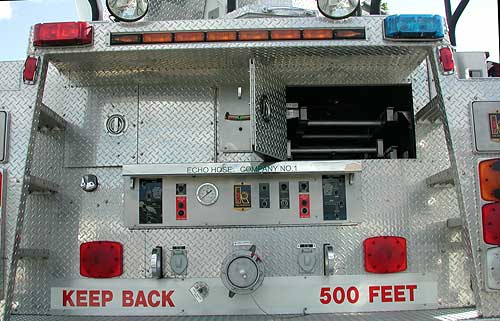
Bad Design: Too Close to the Fire Truck

Sign of the back of the fire truck

As I was headed home the other day, I stopped behind a fire truck at a red light. As soon as I saw the sign that reads, “KEEP BACK 500 FEET,” I stopped. I was probably 25-30 feet behind the truck. I started to feel guilty about not following the instructions that are likely for my safety, but then I thought about how far 500 feet is.The only way I could conceptualize 500 feet was in terms of football fields. For those of you like me, 500 feet is almost 2 football fields! I wouldn’t have even been able to see the sign from that distance. Even if the sign covered the entire back of the truck, I probably wouldn’t be able to read it from that far away (and that’s assuming nothing was in my line of sight and I was paying attention to it). Continue reading

Bad Design: Series Introduction

The bad design series highlights designs of objects that I think are confusing, inefficient, or ineffective. The concept for these posts are similar to the concept for a program that the Georgia Tech chapter of the Human Factors and Ergonomics Society uses at many of its outreach events. In this program, we help people understand the importance of human factors by showing them pictures of poorly designed objects to demonstrate the effect of design on users. I’ll be doing the same in this series. To tie back to the theme of the “learning experiences and educational technology” blog, I’ll connect what makes the design of objects poor to what can make the design of instruction poor.
Continue reading